Environment: Powering the Environmental Transition
Sonepar is committed to accelerating the environmental transition. We reduce our carbon footprint, promote circularity, and protect biodiversity. Our actions reflect our Purpose: Powering Progress for Future Generations.
As the global leader in B2B electrical distribution, we are uniquely positioned to accelerate the energy transition and lead by example.
Download Sonepar's CSR Report.
Download Sonepar's Environmental & Energy Transition Policy.

100% electric power generated from renewable energy sources by 2030.
Sonepar aims to consume 100% of green electricity across its operations. This includes electricity from green providers or from its own production for at least 15%.
100% LED Lighting by 2030.
Sonepar plans to have 100% LED lighting in every building.
100% Low Carbon Cars by 2030.
Sonepar's goal is to have 100% low carbon cars in its internal fleet: electric, plug-in hybrid or ethanol.
100% Waste recycling in warehouses by 2030.
Sonepar targets 100% of waste recycling in warehouses.
100% Energy management by 2030.
Sonepar intends to have an energy management system in 100% of its warehouses in order to better manage and control the energy consumption
The lowest CO2 alternative in each quotation by 2028.
Sonepar's goal is to transform its supply chain to promote products with environmental performance.
“In today’s rapidly evolving world, organizations must remain agile and responsive to both internal and external challenges. At Sonepar, we have strengthened our sustainability strategy to align closely with our Purpose: “Powering Progress for Future Generations.” This strategy is anchored in our Bold Commitments - a set of six priorities that reflect our dedication to people, the planet, and society as a whole.”
- Jessica Lam, SVP Sustainability

Validated climate action: SBTi commitment
We have our greenhouse gas emission targets validated by the Science Based Targets initiative (SBTi), an organization that helps businesses set ambitious goals aligned with the latest climate science. Building on the targets validated in 2022, Sonepar has further reinforced its decarbonization ambition.
- Scope 1 & 2 GHG emissions: we now aim to achieve a 50.4% absolute reduction by 2030, compared with 46.2% previously (2022 validated target).
- Scope 3 GHG emissions: our ambition has significantly increased to a 27.5% absolute reduction by 2030, up from 13.5% previously (2022 validated target).
Recognized performance: EcoVadis platinum rating
In 2025, Sonepar earned a Platinum Rating from EcoVadis, placing us in the top 1% of rated companies worldwide. EcoVadis evaluates organizations across four key areas: Environment, Labor and human rights, Ethics, Sustainable procurement.
This recognition reflects our Group’s global efforts to improve environmental and social outcomes while reducing risk and driving performance.
Sonepar achieved a CDP Climate B-score
Sonepar is proud to have achieved a CDP Climate Change score of B, reflecting our commitment to environmental transparency and continuous progress on our climate journey.
CDP scores are a globally recognized benchmark for corporate environmental transparency. Formerly known as the Carbon Disclosure Project, CDP is an independent, global non-profit organisation that assesses companies on their environmental performance, including climate strategy, governance, risk management, and emissions reporting.
Circularity services
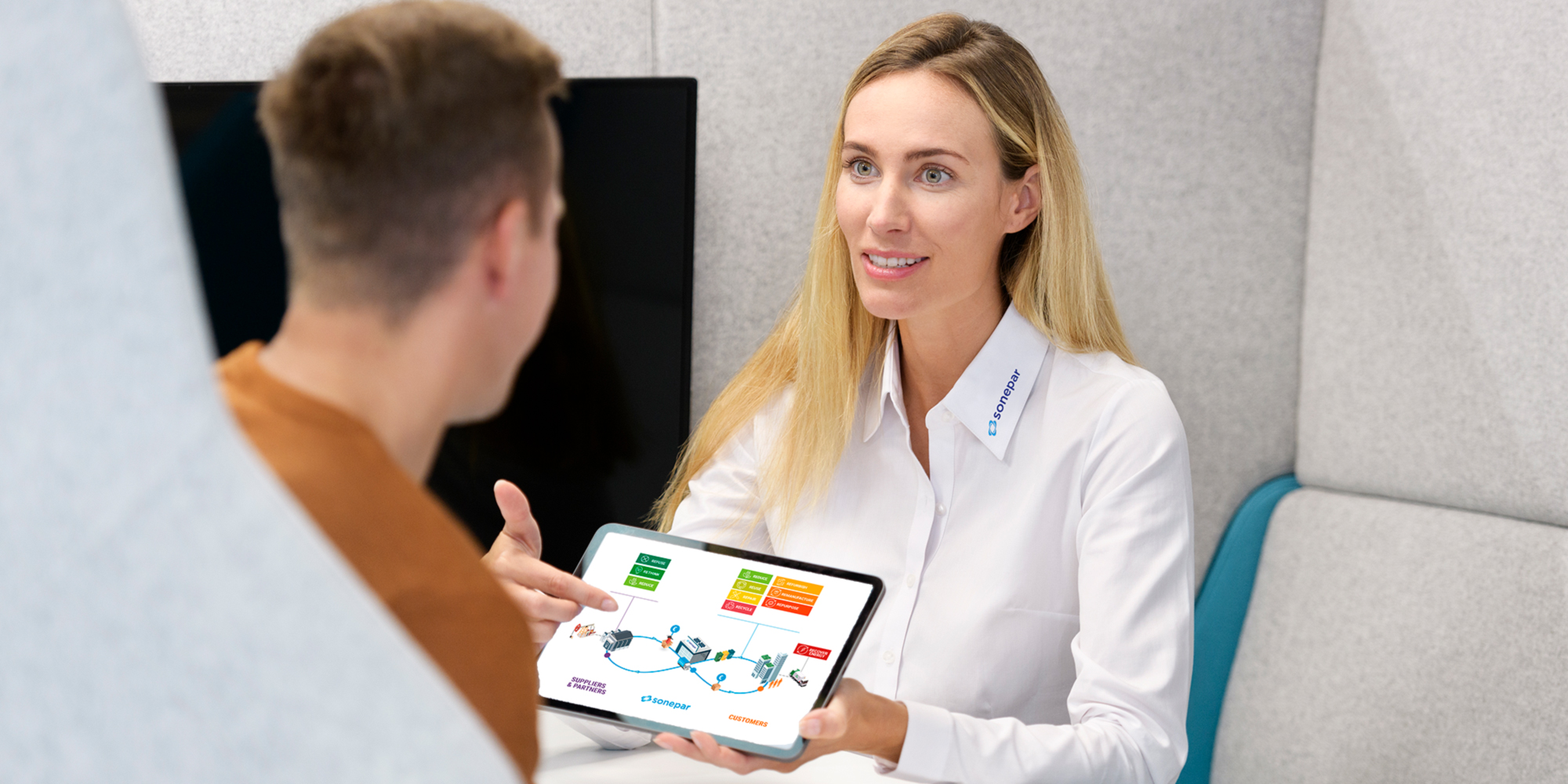
Sonepar engages its associates in the development of sustainable actions and solutions for customers to give products a second life.
This includes product collection for recycling, product repair services and a pilot project to sell secondhand products.
Sonepar wants to accelerate partnerships with suppliers to better structure waste collection and develop new models to extend the product’s life within its value chain.
Energy Transition Academy
In 2020, we launched the Sonepar Energy Transition Academy, a compulsory training program designed to raise awareness about climate change and promote best practices among all our associates.
In 2023, we released the second sustainability training module on circularity and waste management.
The third module about sustainable solutions has been released in 2026, to explore what constitutes a sustainable solution within the Sonepar catalogue and how it can deliver real benefits in everyday business scenarios.
Frequently Asked Questions about our Environmental & Energy Transition Policy
What is the role of associates in Sonepar’s sustainability strategy?
Associates are central to Sonepar’s sustainability journey. Their roles include:
- Participating in annual sustainability training through the Energy Transition Academy
- Promoting sustainable solutions as part of the salesforce
- Engaging in local community initiatives and education programs
- Supporting circularity by facilitating product collection, repair, and recycling
- Contributing to the Sonepar Powering Community Program, which helps vulnerable people including in case of natural disasters
What are Sonepar’s targets for reducing carbon emissions?
Sonepar has set ambitious carbon reduction targets validated by the Science Based Targets initiative (SBTi). By 2030, Sonepar aims to:
- Reduce Scope 1 and 2 emissions by 46.2% (energy, refrigerants, internal fleet and electricity) compared to 2019.
- Reduce Scope 3 emissions by 13.5%.
- Achieve 100% green electricity consumption (including 15% from own production).
- Deploy 100% LED lighting in all buildings.
- Ensure 100% of company cars use low-carbon technologies.
- Recycle 100% of waste from warehouses.
How are associates trained for the energy transition?
Sonepar invests in continuous education for all associates through the Energy Transition Academy. Key points include:
- Annual sustainability training for all associates by 2028.
- 100% of associates trained on CO₂ footprint and circularity modules.
- 100% of the sales force trained on sustainable solutions by 2028.
- In 2025, 81% of associates were trained on sustainability and 90% on circularity.
- The Academy aims to create a culture of responsible, knowledgeable advocates for sustainability across the company.
What is Sonepar’s approach to product circularity?
Sonepar’s approach to product circularity is ambitious and comprehensive. By 2028, Sonepar aims to use packaging made from 100% recycled materials and recycle 100% of products returned by customers. The company integrates circularity into its sustainability strategy, focusing on minimizing waste and maximizing resource efficiency throughout the product lifecycle. Sonepar leverages its global network of distribution centers and branches to offer services that give products a second life, including collection for recycling, repair, and soon selling secondhand products.
- 100% recycled packaging by 2028.
- 100% returned products recycled or resold by 2028.
- Product collection, repair, and refurbishment services.
What are scope 1, 2, 3 emissions?
Scope 1 emissions
Direct greenhouse gas emissions from sources a company owns or controls. Example: fuel burned in company vehicles or boilers.
Scope 2 emissions
Indirect emissions from the electricity, steam, heating or cooling a company buys.
Scope 3 emissions
All other indirect emissions across the value chain. Example: purchased goods, business travel, product use, and end of life.
Related content
Sustainable Customer Journey
We help our customers make informed, sustainable choices by providing them relevant solutions, including Product Carbon footprint.
Interactive Map
Discover our Purpose and sustainability initiatives around the world.
Social
At Sonepar, people are our greatest strength. We foster inclusion, empower communities, and ensure health and safety.
Last updated on May 2026.